Marble and granite resining: Pedrini process and solutions
The resining of natural stone is an operation that consolidates the slab and improves the mechanical and aesthetic characteristics of the processed materials, enabling the commercialization of stones with highly valuable colorations that cannot be used in their natural state. In this article, we will see how marble and granite resining works, why the process changes from one material to another, and how Pedrini automates every step with the Resinline.
In this article, we will look at:
- What marble and granite resining is and why it is a key stage in natural stone processing
- Materials compared: why the resining process changes according to the material
- The stages of marble and granite resining: from loading to catalysis with Resinline
- The advantages of resining: aesthetics, strength, and waste reduction
- Automation and speed: why microwave technology makes the difference
- Assistance and customization: how Pedrini supports your resining line
What marble and granite resining is and why it is a key stage in natural stone processing
Resining is a treatment in which an epoxy resin is made to penetrate the surface of a slab and is then hardened through catalysis. The resin fills cracks and pores, strengthens the stone, and prepares a uniform surface for the subsequent honing and polishing stages.
It takes place immediately after cutting and before finishing operations. At this stage of the production cycle, the slab is still vulnerable but is about to undergo the most demanding processes. If the material is fragile or defective, the risk of breakage is high precisely when the value of the slab has already increased significantly.
The treatment is particularly useful when:
- the slab has veins and microcracks that are at risk of failing during handling and polishing
- the material is particularly fragile and requires a reinforcing net, applied to the back of the slab and bonded with epoxy resin
- there are surface defects that polishing alone cannot resolve
- production requires consistent quality from one slab to another.
For companies evaluating whether to integrate this stage into their production cycle, the question is not only whether to apply resin, but how: a manual process depends on the operator, while an automated process makes timing, dosing, and results repeatable.
Talk to Pedrini experts and find the best resining solution for your production!
CONTACT US
Materials compared: why the resining process changes according to the material
In general, marble and granite blocks may have varying levels of porosity and therefore absorb resin more or less easily into their main veins. They may also have varying degrees of compactness, causing the resin to penetrate only into the microcracks between one crystal and another.
The table below summarizes these general concepts:
| Processed block characteristics | ||
|---|---|---|
| CHaraCTERISTICS | MarBLE | GranitE |
| Structure | Veined rock, often fractured | Compact rock, composed of crystals |
| Porosity | Higher | Lower |
| Where the resin acts | Porosity and widespread fractures | Microcracks between crystals |
| Primary objective | Consolidate and make the slab more uniform | Repair defects and enhance polishing results |
The differences in the characteristics of the processed material translate into concrete operating parameters: the quantity of resin to be applied, the slab temperature, and the catalysis time must all be calibrated according to the material. With an automated plant, these values can be set and repeated consistently, eliminating reliance solely on the operator’s experience.
The stages of marble and granite resining: from loading to catalysis with Resinline
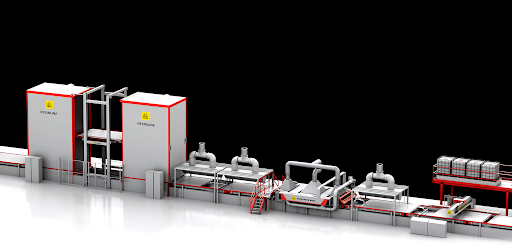
Pedrini’s complete Resinline automates the entire process cycle: slab loading, drying and preheating, resin application with the Gravity B480 Cartesian robot, catalysis in the V-WAVE B460 microwave oven, and final unloading. Every stage is designed to reduce manual intervention and ensure consistent results.
- Loading. The slab is placed on mobile supports that facilitate its transport along the line. For handling operations, Pedrini offers the Butterfly B416 automatic loader and unloader.
- Drying and Preheating. The drying tunnel or drying tower removes residual moisture and brings the slab to the temperature required for resining, approximately 40°C.
- Resin Application. The automatic mixer, which can be connected to Gravity B480, prepares the resin mixture. The robot acquires the slab’s dimensions and shape, calculates the tool path, and distributes the resin with precision. Parameters can be programmed through a touch-screen control panel.
- Catalysis. The slab enters the V-WAVE B460 oven, where the resin penetrates and is activated deep within the material, uniformly throughout the entire volume of the slab. This is followed by retouching operations and entry into the catalysis tower, where the resin curing process is completed.
- Unloading. The treated slab exits the line, ready for honing and polishing.
Would you like to find out which Resinline configuration best suits your production needs? Speak with a Pedrini expert.
CONTACT US
The advantages of resining: aesthetics, strength, and waste reduction
The main advantage of resining is threefold: more attractive slabs, greater strength, and reduced waste. The treatment acts on the stone’s structure, not just on its appearance, and its benefits can be seen throughout the entire production process.
- Aesthetics: The resin makes the surface more uniform and prepares the slab for improved polishing, resulting in a more consistent finish.
- Strength: By filling cracks and pores, the resin reduces the risk of breakage during handling, polishing, and transportation.
- Reduced waste: Thanks to resining, it is possible to produce large-format slabs even from highly veined materials with high aesthetic value, which would otherwise lack the mechanical properties required for cutting and polishing operations.
- Production continuity: Fewer stoppages and less rework result in a more predictable and efficient production flow.
| WITHOUT RESINING | WITH RESINING |
|---|---|
| Risk of breakage during processing | Consolidated slab |
| Visible surface defects | More uniform surface |
| Defective slabs must be discarded | Slabs can be recovered |
| Variable quality from slab to slab | More consistent quality |
Automation and speed: why microwave technology makes the difference
Catalysis is the stage that largely determines the speed of a resining line. The V-WAVE B460 oven combines microwave technology with a Vacuum system: the microwaves reduce the resin’s viscosity, promoting deeper penetration and uniform activation, while the vacuum removes moisture from the environment and helps the resin penetrate more deeply into the stone. The cycle is fully automated and takes place with the doors closed, ensuring complete safety for the operator.
| OperaTION | TradiTional CATALYSIS | MicroWAVE WITH V-WAVE B460 |
|---|---|---|
| Catalysis time | Longer | Reduced |
| Resin activation | Heat starts from the outside of the slab | Uniform, including deep within the slab |
| Retouching and polishing | More demanding | Simplified retouching, improved polishing results |
| Space required for storage | Greater | Smaller |
| Energy consumption | Higher | Reduced |
Microwaves and Vacuum technology in a single machine
Air extraction eliminates humidity and other contaminants present in the atmosphere. In addition, by removing air bubbles from cracks and fissures, it allows the resin to penetrate more deeply, providing a significant advantage in slab restoration and reinforcement. The V-WAVE B460 is compatible with any epoxy resin and develops temperatures suitable for all types of marble and granite. After passing through the oven, the slab can complete the catalysis process in the dedicated catalysis tower.
Would you like to discover how the V-WAVE B460 can reduce your catalysis times? Explore the machine's technical specifications and request a technical consultation with the Pedrini team.
Support and customization: how Pedrini supports your resining line
A resining plant is only as effective as the support behind it. Pedrini supports customers before, during, and after installation, because a reliable line is a line that keeps running.
- Field testing: You can validate the process on your own materials before making a decision.
- Plant customization: The line can be configured according to your production layout, the type of resin used, and the desired level of automation.
- On-site after-sales service: Technicians can intervene directly at your facility when needed.
- Remote support: Many issues can be resolved remotely, reducing downtime and ensuring faster recovery.
Do you want a marble and granite resining line designed specifically for your plant? Talk to a Pedrini expert. We'll start with your materials, your production volumes, and the space available in your facility.
CONTACT US
Related machines
Related news
Thank you for your message.
Error
Do you need more info?
Feel free to contact us for product information, events, customer care and open jobs.