ENGLISH

Granite calibrating machines: the Pedrini range

logo
Giada Rota
06 November 2026

Granite is one of the hardest stones processed in industrial plants: on the Mohs hardness scale, it ranks around 6-7, compared to 3-4 for marble. For this reason, the calibration process, which brings strips and slabs to a uniform thickness, requires granite calibrating machines specifically designed to remove such a resistant material without compromising precision. Below, you will find the Pedrini machines dedicated to this application and the criteria for choosing the model best suited to your production requirements.


Contents


Calibration: Pedrini solutions for granite strips and slabs

For granite calibration, we offer two machines, designed for two different production formats: the Supernova B065GV-B090GV for strips and the Spectra B170/B220 for slabs.


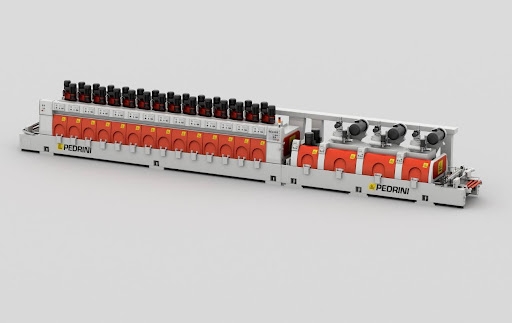
Supernova B065GV-B090GV: calibration, honing and polishing of strips

The Supernova-G calibrates, hones and polishes granite strips in a single line: the material enters to be calibrated and comes out finished. The product is intended for the industrial production of granite floor tiles and modular granite tiles (modulgranito). There are two models, distinguished by strip width: B065, from 300 to 650 mm, and B090, from 300 to 920 mm. The workable thickness ranges from 10 to 50 mm, up to 100 mm on request. The machine can be configured for calibration only, calibration and honing, calibration and polishing, or polishing only.


Spectra B170/B220: slab thickness grinding

The Spectra is a planetary calibrating machine that grinds the thickness of large-format slabs, up to 2,200 mm in width, with workable thicknesses from 10 to 100 mm. The heart of the machine is the Grifone head: a rotating structure with multiple independent electric spindles, each equipped with a 205 mm diamond tool arranged radially on a circumference larger than the working width. In this way, the head covers the entire slab surface, benefiting flatness and thickness uniformity. In addition to granite, the Spectra processes marble, quartzites and engineered stone materials.

 

How the calibration process of granite strips and slabs works

Calibration means removing material from the surface until a constant thickness is achieved over the entire piece, eliminating the irregularities left by the cutting process. The process consists of three stages.


  • Slab thickness reading. On the Spectra, before the slab reaches the heads, a group of adjustable vertical feelers mounted on the infeed roller conveyor measures the thickness by means of linear transducers. This is the starting data for the entire machining process.

  • Grinding with diamond tools. On the Supernova-G, calibration is carried out by tilting helical-shaped diamond rollers, positioned at the machine entry and available in different quantities, with a high material removal capacity. On the Spectra, the calibration is performed by the Grifone heads, from 2 to 4 depending on the configuration, with diamond tools arranged radially. On the B220 version, a configuration with 3 Grifone heads followed by 2 honing heads is also available.

  • Conveyor belt speed management. The feed speed determines how long the material remains under the tools and, consequently, the productivity of the line. On the Supernova-G, the belt speed can be adjusted from 1.5 to 6 m/min on the B065 model and from 1.5 to 5 m/min on the B090. The number and type of heads are defined according to the material, the feed speed and the required processing operations.


On the Supernova-G, after calibration, the material proceeds to the honing stage, with Aquila heads mounted on patented Rotor spindles, and then to the polishing stage, with 7-sector Antishock heads that actuate the abrasives in sequence with a high-frequency oscillating motion. The Smart Contact millimetre downfeed system prevents the spindle from descending below a predefined position.

Why granite requires a specific calibration process


Marble and granite are both natural stones, but they have very different origins and compositions. Marble is composed mainly of calcite and dolomite and has a Mohs hardness of approximately 3-4. Granite, on the other hand, is an igneous rock composed of quartz, feldspars and micas, with a hardness of approximately 6-7 and, for some varieties, a compressive strength reaching 2,500-4,000 kg/cm².


These characteristics have direct consequences for the calibration process:


  • The presence of quartz, the hardest mineral among its components, requires diamond tools capable of removing material without losing effectiveness;
  • The higher wear resistance makes material removal more demanding: the number of heads, the type of tool and the feed speed must be sized according to the material being processed;
  • A configuration designed for marble does not guarantee the same result when processing granite.


For this reason, we distinguish between different Supernova versions: the B065GV-B090GV is dedicated to granite, while the B065MV, B080MV and B100MV are designed for marble, as explained in our dedicated article on the marble calibrating machine.

How to choose the right calibrating machine for granite

The choice is based on five criteria.


  • Final product. If you produce granite floor tiles or modular granite tiles (modulgranito) starting from strips, the Supernova B065GV-B090GV takes the material from calibration through to polishing. If you process large-format slabs, the solution is the Spectra B170/B220.
  • Width. Strips up to 650 mm can be processed with the B065 model and up to 920 mm with the B090; slabs up to 2,200 mm can be processed with the Spectra.
  • Workable thicknesses. From 10 to 50 mm on the Supernova-G, up to 100 mm on request; from 10 to 100 mm on the Spectra.
  • Required productivity. Conveyor belt speed and the number of heads are key factors: on the Supernova-G, belt speed reaches 6 m/min (B065) and 5 m/min (B090); on the Spectra B220, speed reaches 2.2 m/min.
  • Processes to be integrated. Calibration only, or calibration combined with honing and polishing; polishing lines including the Spectra can process either the exposed face only or both faces of the slab.


The safest way to validate the configuration is to see it operating on your own material: this is also one of the purposes of our Research & Development Centre.


CONTACT US

Advantages of high-quality calibration: less waste, greater productivity

Calibration is the starting point for all surface-processing operations: any defect left at this stage will carry through to the finished product.


  • Less waste. Uniform thickness reduces the number of out-of-tolerance pieces and allows only the necessary amount of material to be removed, without sacrificing more stone than required.
  • Uniform finished product. Strips and slabs with the same thickness ensure a regular surface during installation, and the flatness achieved during calibration provides the foundation for consistent polishing results.
  • Faster subsequent processing. When the surface arrives already flat, honing and polishing need only refine the material rather than correct imperfections, reducing processing time in the downstream stages.


On a line such as the Supernova-G, which performs calibration, honing and polishing in sequence, these advantages are compounded: the piece passes through all processing stages without intermediate transfers between different machines.

Service and reliability: why choose Pedrini for granite calibration

The performance of a calibrating machine is measured over the years, not only during commissioning. For this reason, our commitment does not end with the delivery of the machine.


How to choose the right calibrating machine for granite
The choice is based on five criteria.
SUPERNOVA-GB065GV · B090GV SPECTRAB170 · B220
1 Final product
SUPERNOVA-G
Granite floor tiles or modulgranito starting from strips: takes the material from calibration to polishing.
SPECTRA
Large format slabs.
2 Width
SUPERNOVA-G
Strips up to 650 mm (B065) or up to 920 mm (B090).
SPECTRA
Slabs up to 2.200 mm.
3 Workable thickness
SUPERNOVA-G
From 10 to 50 mm, up to 100 mm on request.
SPECTRA
From 10 to 100 mm.
4 Required productivity
Conveyor belt speed and the number of heads are key factors.
SUPERNOVA-G
Conveyor belt speed up to 2,2 m/min.
SPECTRA B220
2, 3 or 4 Grifone heads, or 3 Grifone and 2 honing heads.
5 Processes to be integrated
Calibration only, or calibration combined with honing and polishing.
SUPERNOVA-G
Takes the material from calibration through to polishing.
SPECTRA
In polishing lines: exposed face only or both faces of the slab.


  • On-site service. Our qualified technicians intervene directly at the customer's premises and, during the intervention, also train the technical personnel who will operate the machine.
  • Remote assistance. Machines equipped with an internet connection can be connected to the remote assistance service, providing immediate support without waiting for a technician to travel to the site.
  • Original spare parts. We process spare parts requests from all over the world with rapid response times.
  • Material testing. At the Research & Development Centre, customers can test their own materials alongside our experts to verify the process and optimize production before investing.
  • A widespread network of agents worldwide for consulting, technical-commercial support and after-sales service.


When the range of available machines grows and prices become increasingly similar, the real difference lies in who remains at the customer's side after installation. Since 1962, we have been designing and manufacturing natural stone processing machinery in Italy, with a level of attention that goes well beyond commissioning.


Would you like to find out which granite calibrating machine is best suited to your production requirements? Contact us or book a test on your own material at our R&D Centre.


CONTACT US
image-13

Thank you for your message.

Error

Do you need more info?

Feel free to contact us for product information, events, customer care and open jobs.

Attachment
You can attach here a file of type .doc, .pdf, .png, jpg, .jpeg